
2026-09-05 · 7 min read
Inside a 40 cm Factice: A Case Walkthrough of an Oversized Perfume Bottle
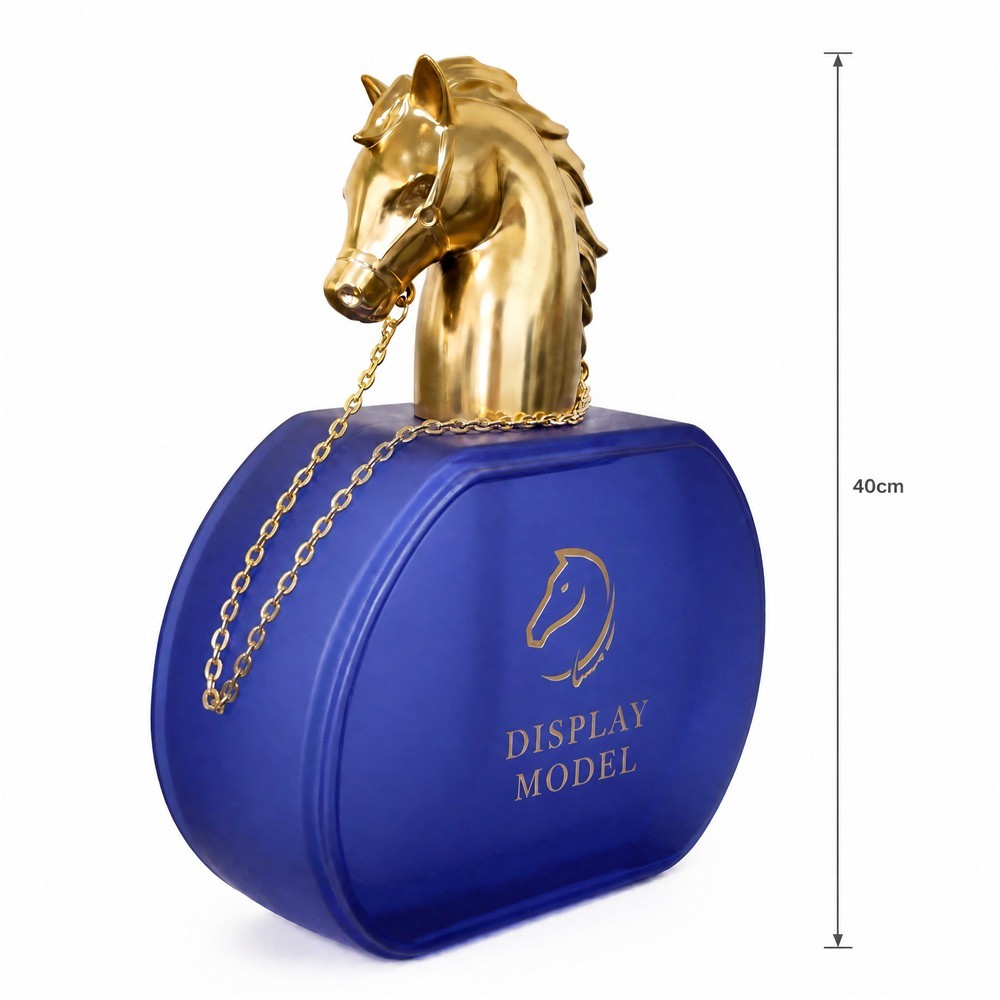
Perfume bottles are small by design — most retail flacons stand well under 20 cm. So when a fragrance house needs a bottle to anchor a window display or a pop-up store, someone has to rebuild that bottle at three or four times its size, faithful enough that customers recognise it instantly. This is the story of one such piece: a 40 cm factice built recently from a customer's own bottle.
The brief
The customer was running a window display and pop-up store programme and needed a display replica of their own perfume bottle. The original design combined a translucent body with a sculptural gold cap — exactly the kind of detail that disappears if the replica is only "roughly right". The target: a freestanding 40 cm model that reads as luxury at close range and survives weeks of retail handling.
Step 1 — Starting from the real bottle
Every factice we build for a brand starts from a bottle the brand owns or is authorised to reproduce. The customer sent a physical bottle, which we measured and photographed, and the cap geometry, shoulder curve and label position were mapped from the original. If you only have a CAD file or technical drawing, we work from that instead — the discipline is the same: nothing gets "interpreted" before it is checked with you.
Step 2 — Rebuilding the geometry
Scaling up is where cheap replicas fail. Wall thickness reads wrong, curves flatten and caps start to look like toys. We rebuild the geometry from the source data and review the proportions with the customer before any surface work begins. For this piece the body is a flattened, rounded form in frosted translucent blue acrylic — acrylic was chosen because it gives that clean, softly glowing translucent look at 40 cm, where solid-colour resins would have read as heavy plastic.
Step 3 — Choosing materials by what the piece must do
- Acrylic for crisp, translucent forms at this size — the frosted treatment softens light and keeps the piece looking premium up close.
- Resin for the sculptural cap — the gold-plated horse head cap is cast and finished separately, so fine detail and plating quality are controlled on their own.
- Fiberglass is the usual answer when a replica grows much larger (think 0.8–1.1 m and up), where weight and structural strength matter more than translucency.
Getting this mix right is the difference between a prop and a display asset. We explain the trade-offs for your size and finish before quoting — send us your briefand we will recommend a construction for it.
Step 4 — Finishing and colour
The frosted surface treatment and the metallic plating are both approved against samples before production. One detail that matters more than most: colour is checked under the lighting the piece will live in. A blue approved under office light can look flat under warm retail spots, so we match finishes to the display environment rather than to a screen.
Step 5 — Standing its ground
A 40 cm display piece at roughly 5 kg is freestanding, but only if the weight sits where it should. We balance the base so the model holds its position without fixings — customers can move it between window and counter without tools.
Step 6 — QC and packing
Dimensions, finish and colour are checked against the approved sample, with QC photos before packing. Display pieces ship in export-standard packing sized to the piece — crating when it is large enough to need it.
Specs at a glance
| Height | 40 cm (custom sizes available, commonly 0.4–1.1 m) |
|---|---|
| Body | Frosted translucent acrylic |
| Cap | Gold-plated resin, sculpted and finished separately |
| Installation | Freestanding, approx. 5 kg |
| Minimum order | from 1 piece |
| Sampling | around 15 days for the first piece |
Common questions
Why not build the model from glass?
Because glass at this scale is fragile, heavy and expensive to ship. Acrylic and resin give the same visual language — translucency, depth, gloss — at a fraction of the weight, and they survive retail environments.
Can the same model be produced in other sizes?
Yes. Once the geometry exists, we can produce the same design across heights — a 40 cm piece for a window, smaller versions for counters, or a larger one for a launch. Tell us the range up front and we will design the construction so it scales cleanly.
How long does the whole process take?
Sampling takes around 15 days for the first piece, then production runs from there. Lead time is quoted against your actual specification — size, finish and quantity — rather than a generic promise.
If you have a bottle that deserves a bigger presence — a window, a counter, an exhibition — the process starts with a brief: send us the bottle or drawing and we will come back with feasibility, materials and a quote. New to factices? Start with our guide to what a factice bottle is, or see the full range of factice perfume bottle models we build.